

As an Amazon Associate, PetKiddies earns from qualifying purchases. We may also earn from other affiliate links on this page at no extra cost to you.
A quick note: we are not vets, and this is not veterinary advice. This guide is research-based, drawing on WSAVA, AAHA, ASPCA and published veterinary research, and we have not hands-on tested the calendars mentioned. If your pet has a health condition or a special diet, check with your vet before adding daily treats.
Last updated: Nov 1, 2026
Pet advent calendars are having a moment. US Google searches for “dog advent calendar” over the past week ran at nearly double their level of the previous four weeks, and some 2026 calendars on Amazon are showing hundreds of purchases in the past month. December is still a month away, but the popular ones tend to sell out before it arrives.
A good calendar can be a fun little daily ritual for you and your pet. A bad one can mean 24 days of extra calories, small parts your dog can swallow, or string your cat should never chew. This guide covers how pet advent calendars work, what to check before you buy, and a few 2026 options for dogs and cats.
Quick answer: are advent calendars safe for dogs and cats?
- Yes, if the calendar is made for pets. Never give your pet a human advent calendar. Most hold chocolate, which is toxic to dogs and cats.
- Count the calories. WSAVA and AAHA advise that treats stay under about 10% of a pet’s daily calories. A treat calendar adds a treat every day, so trim other snacks to make room.
- Match the size. Toys and treats should suit your pet’s size and chewing style. Small balls and bells can be a choking risk for big dogs.
- Watch the strings. Cat toys with string, ribbon or feathers on a cord are for supervised play only, then put away.
- Store it high. A box full of food is a temptation. Keep it where your pet cannot reach it or tear it open.
- Introduce new treats slowly if your pet has a sensitive stomach or allergies, and read the ingredient list first.
What is a pet advent calendar?
An advent calendar counts down the days to Christmas, usually from Dec 1 to Dec 24, with one small door or pocket to open each day. Pet versions swap the chocolate for dog or cat treats, small toys, or a mix of both. Some also include accessories like bandanas, bow ties or a Santa hat.
There are three main types:
- Treat calendars: 24 compartments, each with a biscuit, jerky piece or soft chew. These are usually the lowest-cost option and the easiest to store.
- Toy calendars: a mix of plush, rope, rubber or squeaky toys for dogs, or mice, bell balls, crinkle balls and wand toys for cats. No calories, but more small parts to think about.
- Mixed calendars: a few larger toys with treats on the other days. These tend to be bigger boxes and often sit at the higher end of the price range.
A pet advent calendar is not a necessity. Plenty of dogs and cats are perfectly happy with a normal December. But if your family already opens a calendar every morning, it is a nice way to include the pet, and a daily toy or treat can turn into a short play or training session.
Never share a human advent calendar with your pet
This is the big one. Most human advent calendars are full of chocolate, and chocolate contains theobromine, which dogs break down far more slowly than people do. WSAVA lists chocolate as toxic for cats too. Even when a calendar is hung up out of reach, a determined dog can pull it down and eat several days at once, foil and all.
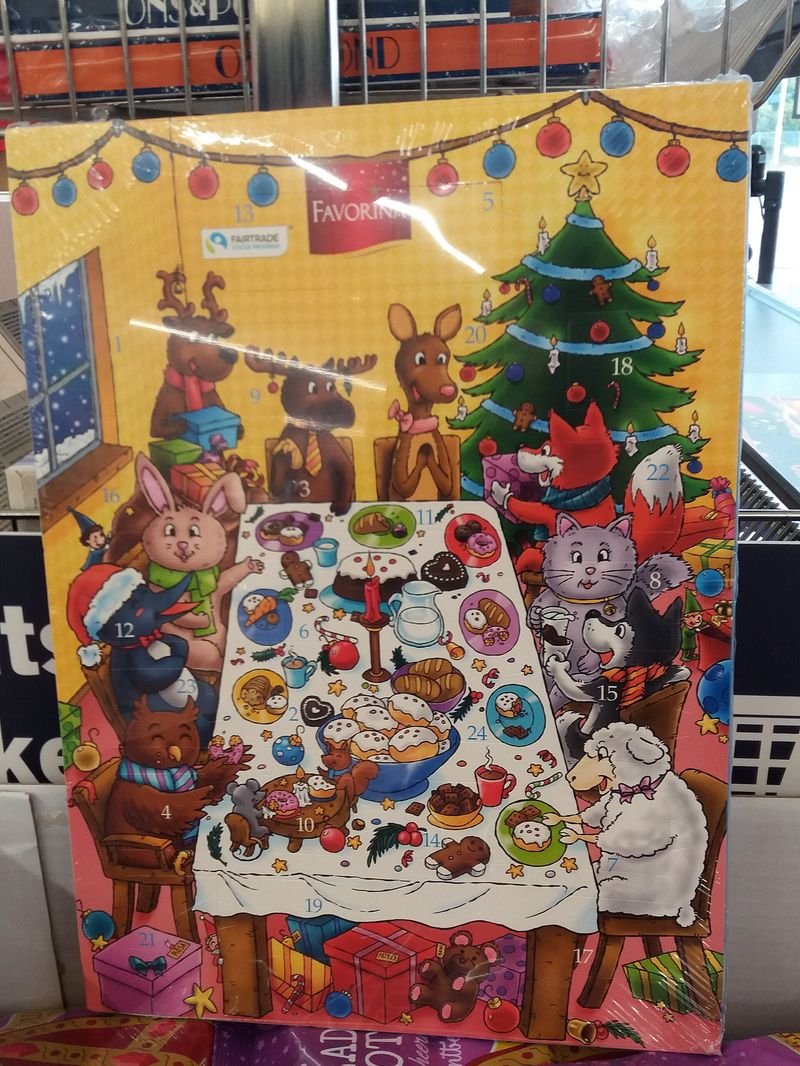
The risk is real at this time of year. A study of electronic health records from 229 UK veterinary practices, published in Veterinary Record in 2017, found that dogs were seen for chocolate exposure about 4.7 times as often around Christmas as on non-holiday dates. The authors listed advent calendars, chocolate Santas and tree decorations among the sources. Most cases in that study were not life-threatening, but they still needed a vet visit, and treatment can include medicine to make the dog vomit.
Signs of chocolate poisoning can include vomiting, diarrhea, restlessness, a racing heart and, in severe cases, seizures. If your pet gets into a chocolate calendar, call your vet or ASPCA Animal Poison Control at (888) 426-4435 right away. Our guide on what to do if your dog ate chocolate walks you through the first steps. Also watch for sugar-free sweets in stocking stuffers: xylitol is very dangerous for dogs, as we cover in our xylitol emergency guide.
How to choose a safe dog advent calendar
Before you buy, read the full listing, not just the title and photos. Here is what to look for:

- Size and chew style. Check the recommended dog size. Many toy calendars are designed for small and medium dogs. A small ball that is fine for a Yorkie can be a choking hazard for a Labrador. Power chewers may shred plush toys in minutes.
- Ingredients. For treat calendars, look for a clear ingredient list and where the treats are made. Skip any calendar that cannot tell you what is inside if your dog has allergies or a sensitive stomach.
- Calories. Most US dog and cat treat labels list calorie content, which AAFCO rules call for. If the calendar does not show it, ask the seller or the brand. WSAVA suggests contacting the manufacturer when calories are not on the label.
- Treat size. Some buyers say treats in larger calendars are too big for small dogs. You can break treats in half and spread them out.
- Packaging. Remove plastic ties, tags and wrappers before handing anything over. BarkBox’s own directions, for example, tell owners to remove all packaging, including plastic fasteners and fabric loops, and to discard any toy that comes apart.
The 10% treat rule, in plain numbers
The World Small Animal Veterinary Association (WSAVA) says treats should make up less than 10% of a pet’s daily calories, and AAHA’s nutrition guidelines say the same. WSAVA’s dog guide gives rough daily treat budgets for an average healthy adult dog at ideal weight. Your vet can give you a figure for your own pet.
| Dog’s weight | Rough daily treat budget (WSAVA) | What that means for a calendar |
|---|---|---|
| 2 kg (about 4.4 lb) | 14 kcal | One small treat may be the whole day’s allowance. Break pieces up. |
| 6 kg (about 13 lb) | 32 kcal | A calendar treat plus one or two tiny training treats. |
| 10 kg (about 22 lb) | 47 kcal | Count the calendar treat and cut back on other snacks that day. |
| 20 kg (about 44 lb) | 79 kcal | Room for the calendar treat plus a few small extras. |
| 30 kg (about 66 lb) | 108 kcal | Still count it, especially if you also give chews or table food. |
One easy fix: on calendar days, use a few pieces of your dog’s regular kibble as training treats instead of extra snacks. AAHA suggests using kibble as treats for exactly this reason.
Advent calendars for cats: what to watch for
Most cat advent calendars are toy calendars, with mice, bell balls, crinkle balls, feather teasers and the odd catnip toy. They can be great for indoor cats, who need daily play. If your cat enjoys a new toy, it is also a good excuse to schedule a few minutes of play each evening. We share more ideas in our guide to interactive toys for indoor cats.

The main risk is anything stringy. Cats love to chew and swallow string, ribbon, yarn and tinsel, and the ASPCA warns that swallowed tinsel can block the digestive tract and may need surgery. Vets call this a linear foreign body. So:
- Use wand and feather toys only while you are playing together, then put them away in a drawer.
- Check yarn balls and fabric toys for loose threads, and throw out anything that starts to come apart.
- Keep bells, small balls and toy parts away from kittens and cats who chew.
- Remove the calendar’s own ribbons, hanging cords and plastic film.
If your cat has swallowed string or ribbon, and you see some hanging from the mouth or bottom, do not pull it. Call your vet right away.
Cat treat calendars exist too, but they are less common. If you choose one, the same 10% rule applies. WSAVA’s cat guide also notes that milk and dairy products can upset many cats, so stick to treats made for cats.
2026 dog and cat advent calendars to consider
We checked these listings on Amazon on Nov 1, 2026. Availability changes fast in November, so check the listing before you buy. We have not tested these products; the notes below come from the brand listings and the number and pattern of customer ratings at the time of checking.
| Calendar | Type | What is inside (per listing) | Best for | Watch out for |
|---|---|---|---|---|
| BarkBox Dog Advent Calendar | Toys + treats | 8 plush toys and 16 bakery-style treats | Dogs of most sizes, gift-giving | Higher-priced box; some buyers say treats are big for small dogs |
| JoyGnaw Dog Treats Advent Calendar 2026 | Treats only | 24 chicken treats, 6.2 oz total | Budget-friendly daily treat | New 2026 listing with few ratings so far |
| Ansee Dog Advent Calendar 2026 | Toys + accessories | Rope, squeaky and chew toys, bandana, bow tie, grooming items | Small and medium dogs | Small parts; not for power chewers |
| Realspring Cat Advent Calendar 2026 | Cat toys | Bell balls, wool balls, toy mice, teaser stick, catnip toys, spring toys | Indoor cats who love to play | String, small parts; supervise and put away |
Best toy-and-treat calendar for dogs
BarkBox’s 2026 calendar mixes 8 plush toys with 16 treats, so your dog gets a toy about every third day. The listing says the toys include squeakers, crinkle textures and tug straps, and it is sold by Amazon directly. When we checked, it was listed as a pre-order with a release date of Nov 1, 2026, so check that it is in stock. It is a bigger box and costs more than most single-type calendars.

Dog biscuits (item type, not the exact product). Photo: Alan Levine from Archydal, Canada, CC BY 2.0, via Wikimedia Commons (resized)
Barkbox Dog Advent Calendar (8 toys + 16 treats)
8 plush toys and 16 bakery-style treats in one box. Sold by Amazon; listed as a pre-order releasing Nov 1, 2026 when we checked.
Check price on AmazonBest treat-only calendar for dogs
JoyGnaw’s 2026 calendar is a simple 24-day treat box, with one chicken treat behind each door and a total weight of 6.2 oz. The listing describes it as grain-free and rawhide-free, says the treats are made in the company’s FDA-registered facility in China, and recommends feeding it as a treat rather than food. It was in stock and shipping from Amazon when we checked. It is a newer listing with only a handful of ratings, so read recent reviews before you order.

Dog treats (item type, not the exact product). Photo: Megan Marrs, CC BY 2.0, via Wikimedia Commons (resized)
JoyGnaw Dog Treats Advent Calendar 2026 (24 days)
24 chicken treats (6.2 oz). Grain-free and rawhide-free per the listing. Count each treat toward your dog's daily treat budget.
Check price on AmazonBest toy calendar for small and medium dogs
Ansee’s calendar is all non-food: rope toys, squeaky toys, treat balls and chew toys, plus festive accessories like a collar with bells, a bandana and a Santa hat, and a few practical items such as a bath brush and poop bags. It is aimed at small and medium dogs, and the brand suggests supervision for strong chewers. A calorie-free calendar is a good pick for dogs on a weight plan.
Plush dog toy (item type, not the exact product). Photo: www.Pixel.la Free Stock Photos, CC0, via Wikimedia Commons
Ansee Dog Advent Calendar 2026 (24 toys and accessories)
Calorie-free: rope, squeaky and chew toys plus festive accessories. Made for small and medium dogs; supervise strong chewers.
Check price on AmazonBest advent calendar for cats
Realspring’s cat calendar holds 24 toys: bell balls, wool balls, toy mice, a teaser stick with spare heads, catnip toys, spring toys and a Santa hat and scarf. The listing itself warns that it includes small items and should be kept away from pets in case of choking. Use the teaser and wool toys during supervised play, then store them.

Cat toy mouse (item type, not the exact product). Photo: Andrew Gray, CC BY-SA 2.0, via Wikimedia Commons (resized)
Realspring Cat Advent Calendar 2026 (24 toys)
24 cat toys including bell balls, mice, catnip toys and a teaser stick. Includes small parts and string-type toys; supervise play.
Check price on AmazonMake a DIY advent calendar for your pet
You do not need to buy a calendar at all. A homemade version lets you control every treat and toy, and it costs very little:

- Use the food you already have. Put a few pieces of your pet’s own kibble or their usual treats in 24 small paper bags or envelopes. Number them and clip them to a string well above pet height.
- Swap treats for activities. Some days can be “new walk route”, “five minutes of fetch”, “brush and cuddle” or “learn a new trick”. Many pets value your time more than a biscuit.
- Rotate old toys. Hide a few favorite toys in late November and bring one back out each day. To your pet, it is new again.
- Keep it pet-safe. Skip ribbon, tinsel, glitter and small plastic decorations, and do not hang it where a dog can jump up and grab it.
Tips for using a pet advent calendar safely
- Open it yourself. Take the treat or toy out and hand it over. Do not let your pet tear into the box.
- Store the calendar high and closed, ideally in a cupboard between openings. A food-filled box on a low table is an invitation.
- Supervise new toys the first few times, and remove tags, plastic and loose parts.
- Adjust meals if needed. If your pet is gaining weight, use smaller pieces or switch to a toy calendar.
- Think about multi-pet homes. Give treats in separate rooms if your pets compete over food.
- Keep the calendar away from other holiday hazards, like lilies, tinsel and wrapped gifts with food inside, which the ASPCA flags in its holiday safety tips.
Shopping for more than a calendar? Our Christmas gifts for senior dogs guide and Black Friday and Cyber Monday pet deals page are updated through the season.
FAQ
Are dog advent calendars safe?
Calendars made for dogs are generally fine for healthy dogs when you choose the right size, read the ingredients and count the treats toward the daily treat budget. Never give a dog a human advent calendar, because most contain chocolate.
When should I start a pet advent calendar?
Most calendars run from Dec 1 to Dec 24. Buy in November if you want a specific one, because popular calendars can sell out before December.
Do cat advent calendars have treats or toys?
Both exist, but most cat calendars are toy calendars with mice, bell balls, feather teasers and catnip toys. Supervise any toy with string, ribbon or feathers on a cord.
How many treats a day can my dog have?
WSAVA and AAHA advise that treats make up less than about 10% of daily calories. For a 10 kg (22 lb) dog, WSAVA’s guide puts that at roughly 47 kcal a day. Ask your vet for your dog’s exact number.
What should I do if my dog eats a chocolate advent calendar?
Call your vet or ASPCA Animal Poison Control at (888) 426-4435 right away. Note what was eaten and how much, and do not wait for symptoms.
Can puppies have advent calendar treats?
Some treat calendars say they suit all life stages, but puppies have small stomachs and growing bodies. Break treats into small pieces, introduce them slowly, and check with your vet if your puppy has any stomach trouble.
Is a toy advent calendar better than a treat one?
A toy calendar adds no calories, so it can suit pets on a diet or with food allergies. A treat calendar has fewer small parts. Choose based on your pet’s weight, diet and chewing habits.
Bottom line
A pet advent calendar is a small, fun way to include your dog or cat in the December countdown. Pick one made for pets, match it to your pet’s size and chewing style, count the treats toward the daily 10% treat budget, and keep string toys and small parts supervised. And keep your own chocolate calendar well out of reach.
If you would rather not buy one, a DIY calendar with your pet’s usual treats, old toys and a few minutes of play each day works just as well.
Sources
- Noble PJM et al. “Heightened risk of canine chocolate exposure at Christmas and Easter.” Veterinary Record, 2017 (via PMC). pmc.ncbi.nlm.nih.gov
- WSAVA, “Feeding treats to your dog” and “Feeding treats to your cat” (accessed Nov 1, 2026). Dogs (PDF), Cats (PDF)
- AAHA, 2021 Nutrition and Weight Management Guidelines: feeding plans (accessed Nov 1, 2026). aaha.org
- ASPCA Animal Poison Control, “Holiday Safety Tips” (accessed Nov 1, 2026). aspca.org
- VCA Animal Hospitals, “Linear Foreign Body in Cats” (accessed Nov 1, 2026). vcahospitals.com
- Google Trends (US) and Amazon.com product listings, checked Nov 1, 2026.