
As an Amazon Associate, PetKiddies earns from qualifying purchases. We may also earn from other affiliate links on this page at no extra cost to you.
A quick note: we are not vets, and we have not hands-on tested the toys below. This guide is research-based, drawing on feline behavior sources such as the AAFP and ISFM, Cornell Feline Health Center and the ASPCA. If your cat’s play or activity level changes suddenly, check in with your vet.
Last updated: Oct 26, 2026
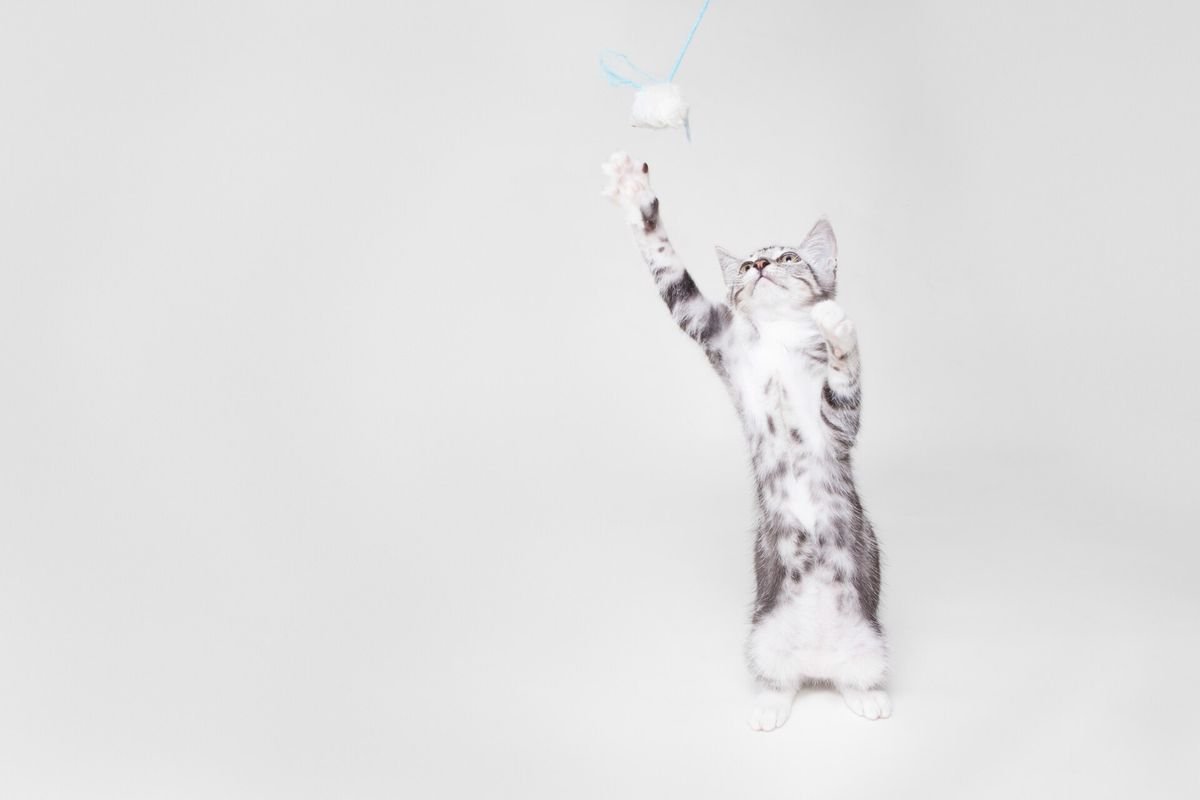
The best interactive cat toys for indoor cats are the ones that let your cat act like a hunter: stalk, chase, pounce and actually catch something. For most cats, that means a feather wand moved by you, backed up by a puzzle feeder or ball track for when you are busy.
National Cat Day is this Thursday, Oct 29 (founded in 2005 by pet and family lifestyle expert Colleen Paige), and plenty of owners are looking for toys that keep cats busy. Here is what works, why, and how to play safely.
Quick answer: the best interactive cat toys for indoor cats
- Best overall for bonding: a feather wand that you move like prey.
- Solo play while you’re out: a ball track or a puzzle feeder.
- Food-motivated or overweight cats: a puzzle or “hunting” feeder that turns part of the daily food into a game.
- Kickers and bunny-kickers: a long catnip or silvervine kicker toy.
- Senior or low-energy cats: short, gentle wand sessions close to the floor.
- For every cat: rotate toys so they stay new, and end every session with a catch.
Why indoor cats need interactive play
Cats are predators, even the ones snoring on your sofa. A hunting cat runs through the same sequence many times a day: locate, stalk, chase, pounce, catch, then eat. The 2013 AAFP and ISFM Feline Environmental Needs Guidelines note that “predatory behavior occurs even in well-fed cats,” so an indoor cat with a full bowl still has that wiring, but often nothing to aim it at.
Those guidelines list five “pillars” of a healthy cat environment: a safe place, multiple and separated key resources, the opportunity for play and predatory behavior, positive and predictable human interaction, and respect for the cat’s sense of smell. You can read the AAFP/ISFM Environmental Needs Guidelines on the AAFP site.
The guidelines warn that cats without outlets for predatory behavior may become bored and frustrated, which can contribute to weight gain, overgrooming, stress-related illness or misdirected aggression. Play is not a cure-all, though. A Cornell Feline Health Center summary estimates 30 to 40 percent of cats are overweight and notes that diet tends to matter more than exercise advice alone. Sudden behavior changes can also have medical causes, so check with your vet.
How much play? There is no official number, but many cat-care sources suggest two or three short sessions a day of roughly 10 to 15 minutes, adjusted for age and energy. Cats hunt in bursts, so short and frequent beats one marathon. Older cats may need a gentler setup; our guide to senior cat environment changes covers easy tweaks.
Types of interactive cat toys compared
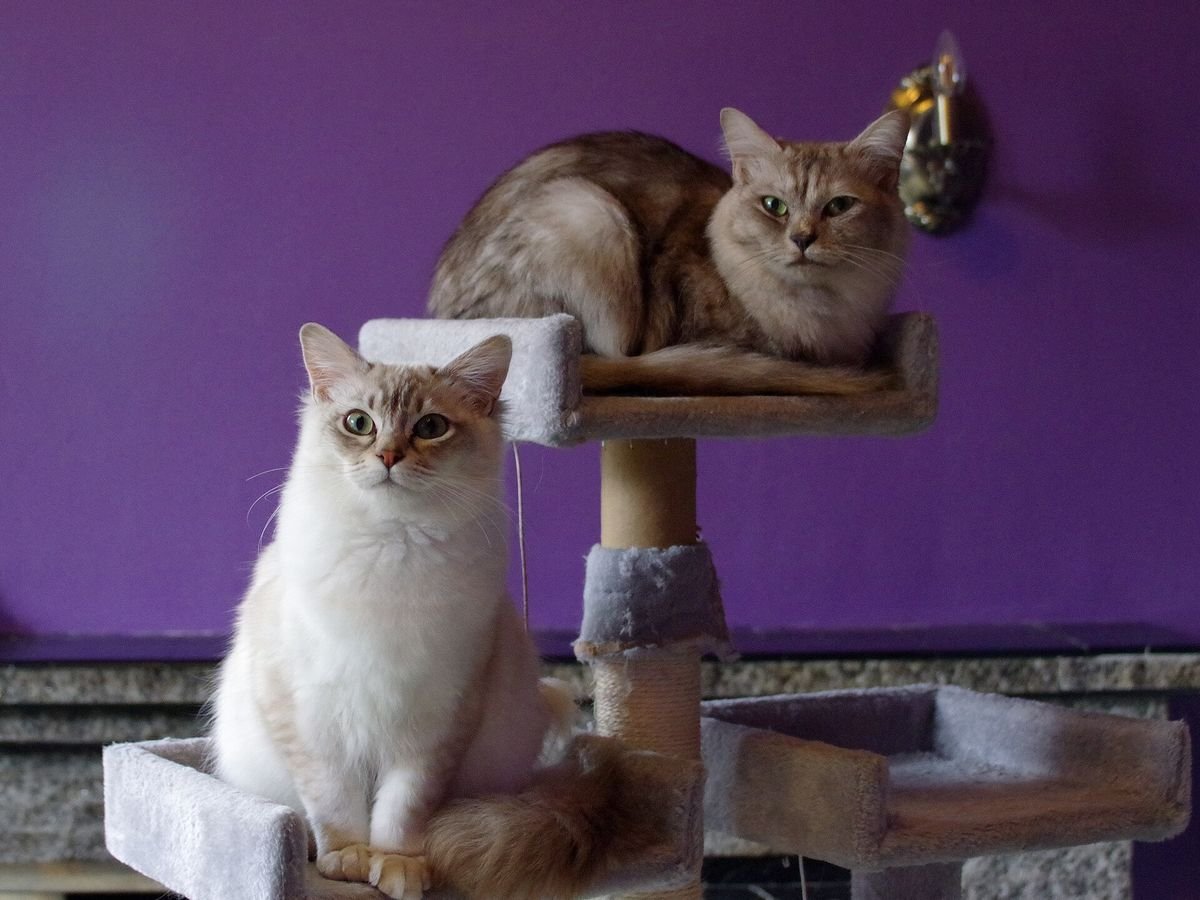
Interactive cat toys fall into a few broad groups. Some need you on the other end, some work alone, and most homes do best with a mix.
| Toy type | Best for | Needs you? | Watch out for |
|---|---|---|---|
| Feather/wand teaser | Bird-chasers, bonding, burning energy | Yes | String and feathers – store out of reach after play |
| Wire teaser (Cat Dancer style) | Jumpers, kittens, budget play | Yes | Wire tip and small parts – supervise |
| Ball track/circuit | Solo play, kittens, multi-cat homes | No | Some cats lose interest quickly |
| Puzzle or hunting feeder | Food-motivated or overweight cats | Partly (setup) | Use part of daily food, not extra; introduce slowly |
| Catnip/silvervine kicker | Bunny-kickers, solo wrestling | No | Not every cat responds; check seams |
| Electronic/motion toy (flopping fish, concealed motion) | Curious cats, short solo sessions | Sometimes | Batteries and charging; can startle timid cats |
| Laser pointer | Quick bursts of running | Yes | Never in the eyes; no catch – finish on a real toy or treat |
| Cardboard scratcher/lounge | Scratching, stretching, ambush spot | No | Cardboard sheds bits over time |
To pick, start with age and energy. Kittens and young cats usually want speed and jumping, so wands and wire teasers fit well. Seniors tend to prefer slower, ground-level movement and toys that do not demand big leaps.
Then think about “prey preference.” The Ohio State University Indoor Pet Initiative suggests a simple prey preference test: try bird-like toys (feathers, things in the air), mouse-like toys (fur, things scurrying along the floor) and bug-like toys (small, darting objects), and see which your cat follows. Many cats have a favorite, and some like variety, so treat it as an experiment.
How to play with your cat like a hunter
The secret to good play is movement, not the toy. Prey does not fly at a cat’s face; it runs away, hides and freezes. So move the toy away from your cat or across their line of sight. Drag it behind a chair leg, pause, then let it “escape” in a quick dash.
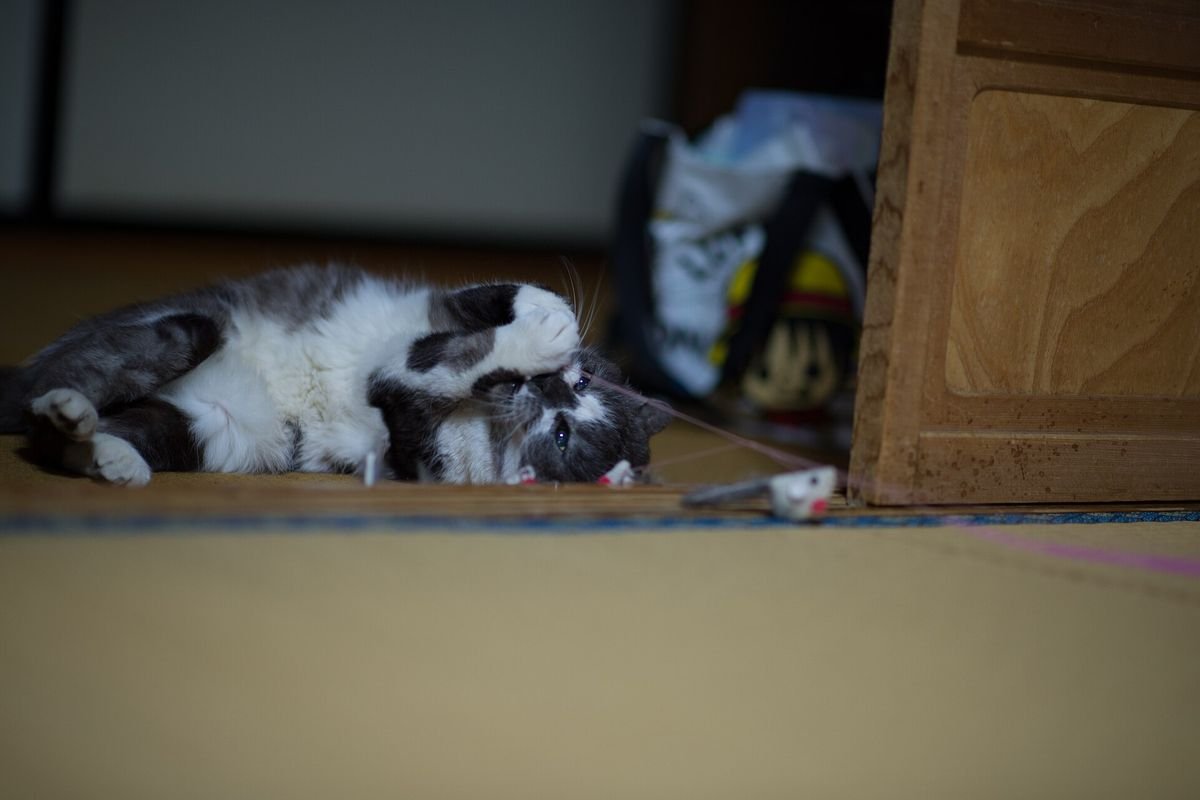
A simple pattern works well:
- Start slow and let your cat settle into a crouch.
- Build up with faster chases, hiding the toy behind furniture between runs.
- Let your cat catch the toy often, not just at the end.
- Slow down for the last minute or two so your cat can cool off.
- Finish with one satisfying catch, then offer a small meal or treat.
That mirrors the natural cycle of hunt, catch, eat, groom and sleep, and the AAFP/ISFM guidelines suggest letting the cat catch the toy and rewarding with a treat after play. Some owners find a session plus a small meal before bedtime helps with nighttime zoomies; it is worth a try.
Watch body language. A lashing tail, flattened ears or grabbing your hand instead of the toy can mean overstimulation, so slow down or end calmly. Never use hands as toys. Kittens do best with frequent short bursts; seniors may want only a few minutes, with the toy kept low.
In multi-cat homes, use one wand per cat or take turns, because a shy cat often hangs back while a bolder one grabs every catch. With a dog in the house, play where your cat feels safe; our slow cat-to-dog introduction guide has more on keeping both pets calm.
Are laser pointers bad for cats?
Laser pointers are not automatically bad, but there are two caveats. Never shine one into your cat’s eyes, and remember that a red dot can never be caught, so the hunt has no ending and some cats seem frustrated afterward.
A 2021 study by Lori Kogan and Emma Grigg in the journal Animals surveyed 618 cat owners and found that more frequent laser play was associated with owner-reported repetitive behaviors such as chasing lights or shadows and staring at lights. The authors stress this is a correlation from an owner survey, not proof that lasers cause these behaviors. Still, it is a reasonable nudge to use lasers sparingly and to finish by landing the dot on a toy or treat your cat can actually grab.
Toy safety: string, feathers and small parts
The biggest toy risk for cats is anything long and thin. String, yarn, thread, ribbon, tinsel and hair ties can be swallowed and become what vets call a linear foreign body. VCA Animal Hospitals describes swallowed thread, string or yarn as potentially life-threatening, because the string can anchor in place while the intestines bunch up along it, sometimes requiring surgery. See VCA’s overview of foreign bodies in cats.
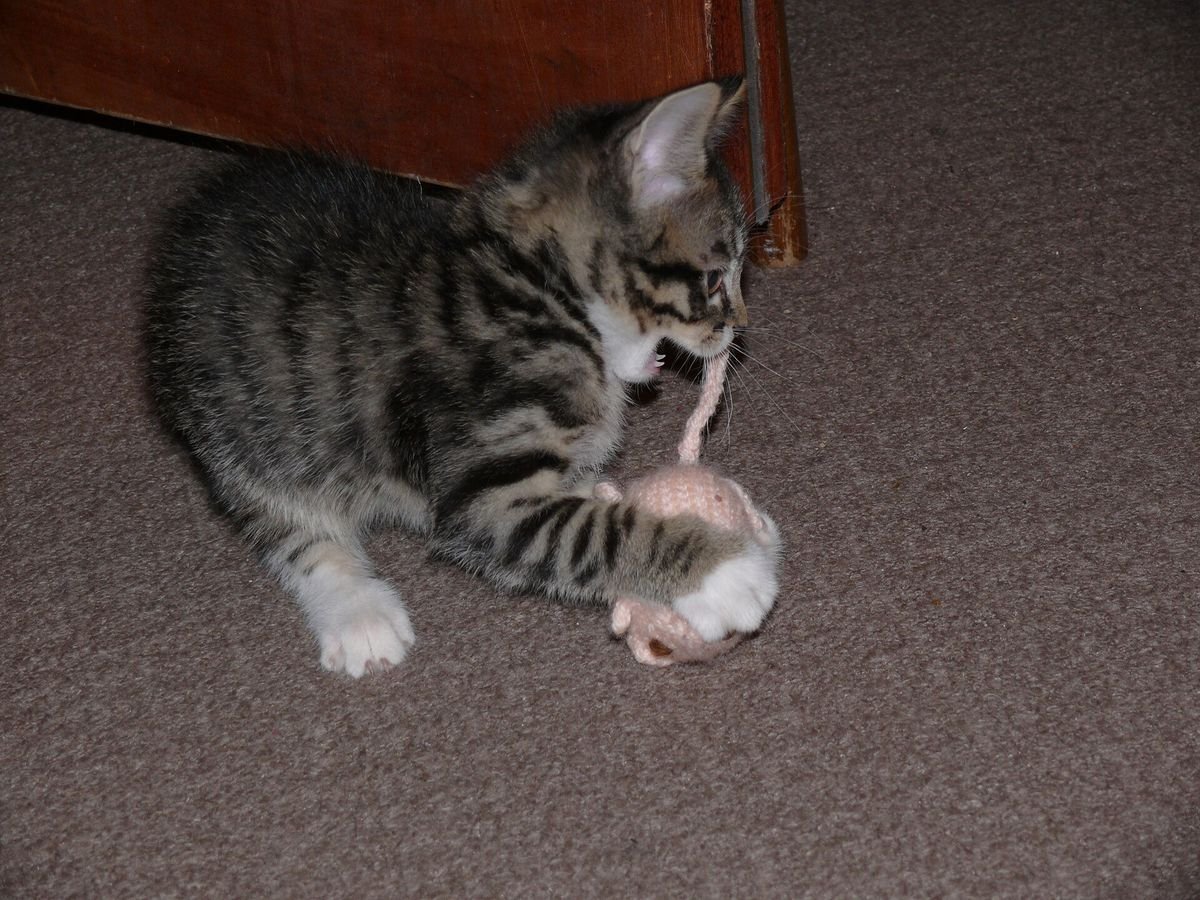
So put wand toys away after every session, ideally in a closed cupboard. Check toys for loose feathers, frayed string, wobbly bells or glued-on eyes, and retire anything falling apart. Supervise new toys, and for electronic ones keep battery covers closed and follow the charging instructions.
Catnip is considered safe for most cats, but not every cat reacts; sensitivity appears to be inherited, and figures of roughly 50 to 70 percent of cats responding are often quoted. In a 2017 study of 100 cats in BMC Veterinary Research, Bol and colleagues found that about one in three cats did not respond to catnip, while almost 80 percent responded to silver vine (silvervine), including many catnip non-responders. If you grow your own catnip or cat grass, see our guide to pet-safe gardening plants.
Call your vet promptly if your cat may have swallowed part of a toy, or shows vomiting, not eating, straining, lethargy, a sore belly or pawing at the mouth. Do not pull on string you can see.
Our research-based picks
These picks are based on behavior guidance and how each design fits common needs, not hands-on testing. Sizes and pack contents vary, and listings and stock change, so check details before you buy.
1. Best overall for bird-chasers: GoCat Da Bird
GoCat Da Bird Feather Wand Cat Toy is a classic rod-and-string wand with a feather “bird” that spins and flutters as you swing it. It suits cats who love to leap at flying things, and replacement feather attachments are widely sold. Store it out of reach after every session because of the string and feathers.
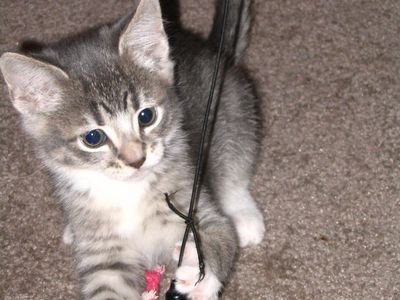
Wand/lure toy (item type, not the exact product). Photo: Dcoetzee, Public domain, via Wikimedia Commons (resized)
GoCat Da Bird Feather Wand Cat Toy
Feather wand for bird-chasers and bonding play; store out of reach after each session.
Check price on Amazon2. Best budget wire teaser: Cat Dancer
Cat Dancer Original Interactive Cat Toy (3-pack) is a springy steel wire with rolled cardboard on the end. It bounces and jitters with tiny hand movements, which many cats find hard to ignore, and the 3-pack means spares. Supervise play and put it away afterward, since the wire tip and cardboard are not for chewing.
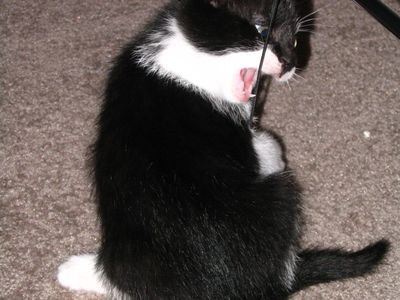
Teaser/lure toy (item type, not the exact product). Photo: Dcoetzee, Public domain, via Wikimedia Commons (resized)
Cat Dancer Original Interactive Cat Toy (3-pack)
Bouncy wire teaser for jumpers and kittens; 3-pack spares; supervise play.
Check price on Amazon3. Best for solo play: Catstages Tower of Tracks
Catstages Tower of Tracks Interactive Cat Toy stacks circular tracks with balls that roll when batted and cannot be pulled out. It suits kittens, playful adults and multi-cat homes. Some cats play with it for weeks while others lose interest fast, so rotating it in and out can help.
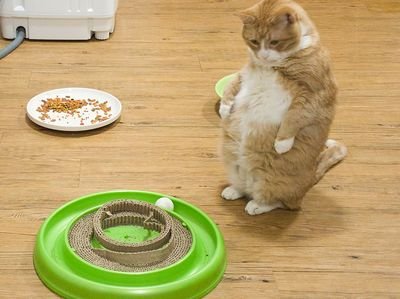
Ball track toy (item type, not the exact product). Photo: Jerry, CC BY-SA 2.0, via Wikimedia Commons (resized)
Catstages Tower of Tracks Interactive Cat Toy
Ball track for solo play, kittens and multi-cat homes; balls stay inside.
Check price on Amazon4. Best for food-motivated cats: Doc and Phoebe’s Indoor Hunting Feeder
Doc & Phoebe’s Indoor Hunting Cat Feeder (SPOT) uses small “mice” that you fill with dry kibble and hide, so your cat has to find and paw out meals. It suits food-motivated, bored or overweight cats. Use part of the daily ration rather than extra food, ask your vet about portions, introduce it gradually and follow the listing’s cleaning directions. It is less useful for cats on an all-wet diet.
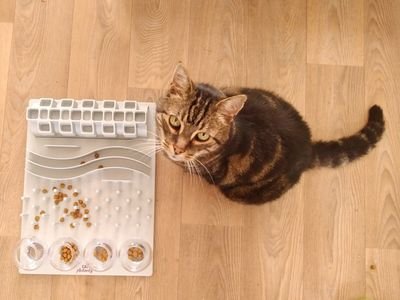
Puzzle/slow feeder (item type, not the exact product). Photo: Anja, CC BY-SA 4.0, via Wikimedia Commons (resized)
Doc & Phoebe's Indoor Hunting Cat Feeder (SPOT)
Hide-and-hunt kibble feeder for food-motivated or overweight cats; use part of daily food.
Check price on Amazon5. Best kicker toy: Yeowww! Catnip Banana
Yeowww! Catnip Banana Toy is a catnip-filled cotton banana (the listing says about 7 inches) that many cats grab, bite and bunny-kick with their back legs. It is a good fit for cats who wrestle their toys. It only really works if your cat responds to catnip, and like any plush toy, check the seams now and then.
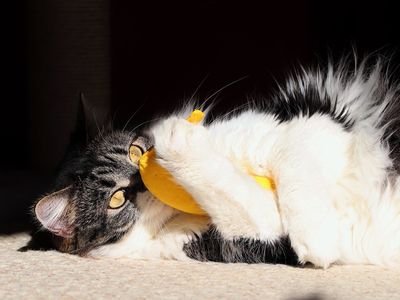
Catnip kicker toy (item type, not the exact product). Photo: Lisa Zins, CC BY 2.0, via Wikimedia Commons (resized)
Yeowww! Catnip Banana Toy
Catnip kicker for bunny-kicking wrestlers; best for cats that respond to catnip.
Check price on Amazon6. Best motion toy: Potaroma Flopping Fish
Potaroma Flopping Fish Cat Toy with Catnip and Silvervine is a rechargeable fabric fish that, according to its listings, starts flopping when it senses movement. The silvervine may appeal to some catnip non-responders. Some cats are scared at first, so introduce it calmly, supervise play and follow the listing’s charging and battery cautions.
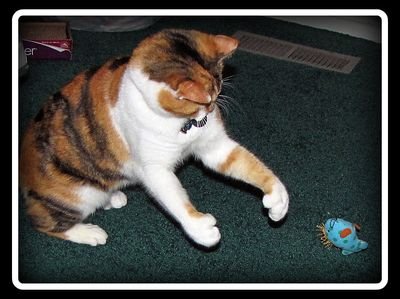
Fish-shaped cat toy (item type, not the exact product). Photo: Trish Hamme from Reno , Nevada, USA, CC BY 2.0, via Wikimedia Commons (resized)
Potaroma Flopping Fish Cat Toy with Catnip and Silvervine
Rechargeable flopping fish for curious cats; silvervine may suit catnip non-responders.
Check price on Amazon7. Best scratcher and pounce spot: PetFusion Jumbo Scratcher Lounge
PetFusion Jumbo Cat Scratcher Lounge is a large curved cardboard scratcher that doubles as a lounging spot. The ASPCA notes cats scratch for reasons including stretching, marking territory and playing, so a good scratcher is a basic need. It also makes a handy ambush spot during wand play. Expect some cardboard shedding.
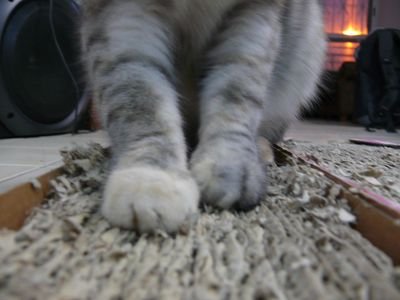
Cardboard scratcher (item type, not the exact product). Photo: Arria Belli, CC BY-SA 2.0, via Wikimedia Commons (resized)
PetFusion Jumbo Cat Scratcher Lounge
Large cardboard scratcher and lounger; doubles as an ambush spot during play.
Check price on AmazonSimple DIY and free ways to keep an indoor cat busy
You do not need to buy much to give an indoor cat a fuller day. A plain cardboard box is a hiding spot, fort and ambush point at once. Paper bags work too, as long as you cut off the handles so your cat cannot get tangled.
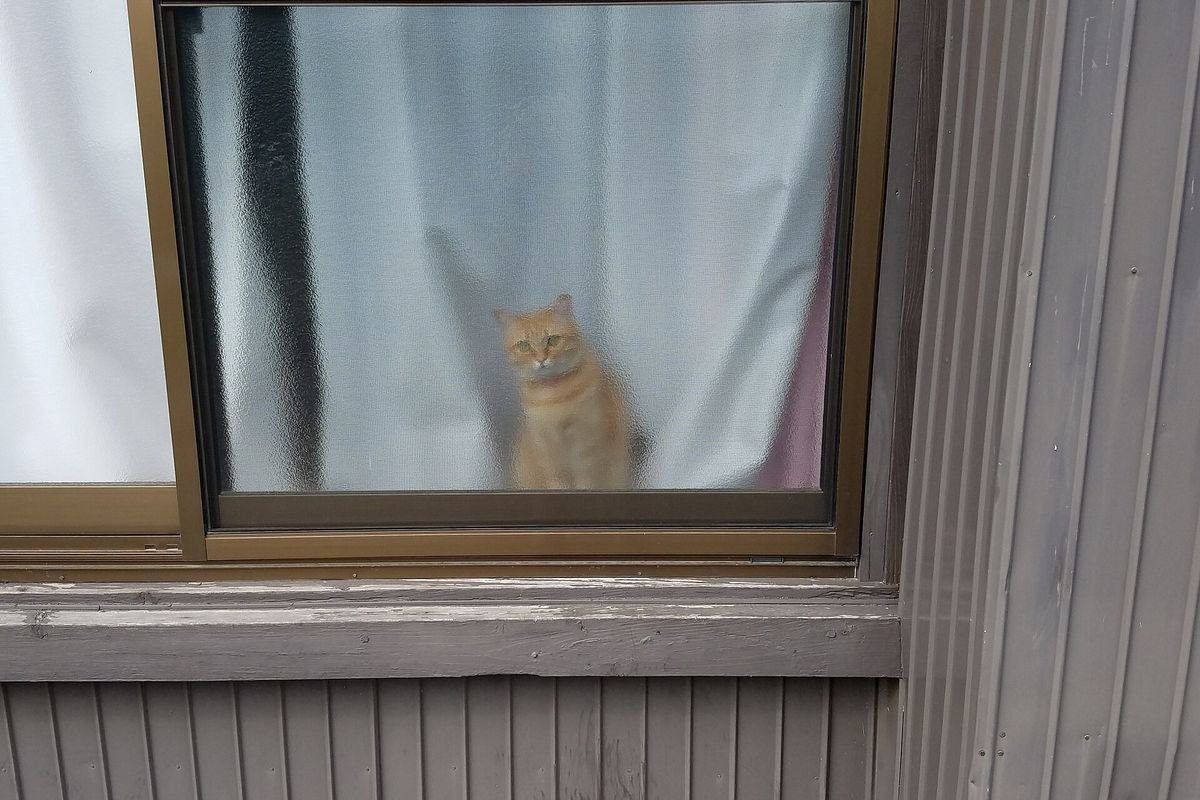
Treat hunts are an easy win: hide kibble around a room, or toss single pieces across the floor to chase – the AAFP/ISFM guidelines suggest hiding and scatter feeding food to mimic hunting. A cat tree adds climbing space, and a window perch near a bird feeder can provide “cat TV.” Some owners also try clicker training; many food-motivated cats seem to enjoy it.
Finally, rotate toys: keep most in a closed box and swap a few out each week. Boredom and stress do not always look obvious – in some cats they may show up as overgrooming, night yowling or litter box changes. Our guide to cat litter box problems walks through causes worth ruling out.
National Cat Day ideas for indoor cats
National Cat Day is a good excuse to refresh your cat’s routine. Most of these take under 15 minutes.
- New toy plus a 10-minute session: try one new toy with a hunter-style session that ends in a catch and a treat.
- Toy rotation reset: toss anything frayed or broken and split the rest into weekly groups.
- Puzzle meal: serve one meal in a puzzle feeder or as a treat hunt.
- Window seat: clear a sunny sill or add a perch with a view.
- Help a shelter cat: adopt, foster, or donate toys and supplies to a local shelter.
If you are stocking up for the holidays, our Black Friday and Cyber Monday pet deals tracker rounds up offers as they appear.
FAQ
How much playtime does an indoor cat need?
There is no official number. Many cat-care sources suggest two or three sessions a day of about 10 to 15 minutes, adjusted for age, health and energy.
Why does my cat ignore toys?
Often the toy is not moving like prey, or it has become boring. Move it away from your cat, try different prey styles and rotate toys. If a playful cat suddenly stops playing, talk to your vet.
Are feather toys safe to leave out?
Wand toys with string or feathers should not be left out unsupervised. Swallowed string can cause a dangerous linear foreign body, so store wands in a closed drawer or cupboard.
Are laser pointers bad for cats?
Not necessarily, but use them sparingly, never aim at eyes, and finish on a real toy or treat. A 2021 owner survey linked frequent laser play to some repetitive behaviors, though it could not prove cause and effect.
What toys are good for senior cats?
Gentle wand play near the floor, soft kickers and easy puzzle feeders. Reluctance to jump can signal arthritis, so mention it to your vet.
Is catnip safe and why doesn’t my cat react?
Catnip is generally considered safe for most cats. The response appears to be inherited, so some cats simply do not react. Silvervine is worth trying, since research suggests many catnip non-responders react to it.
Do cats need toys if they have another cat?
Usually, yes. Each cat still benefits from hunting-style play, and shy cats can miss out when a bolder cat takes over.
How often should I replace or rotate toys?
Rotate a few toys weekly, and replace any toy that is frayed or has loose parts.
Bottom line
The best interactive cat toys for indoor cats let your cat finish the hunt. A feather wand moved like prey, a couple of short daily sessions and a final catch plus a treat cover most of what an indoor cat needs.
Add a puzzle feeder or ball track for alone time, store string toys safely, and rotate toys so playtime stays fresh.