
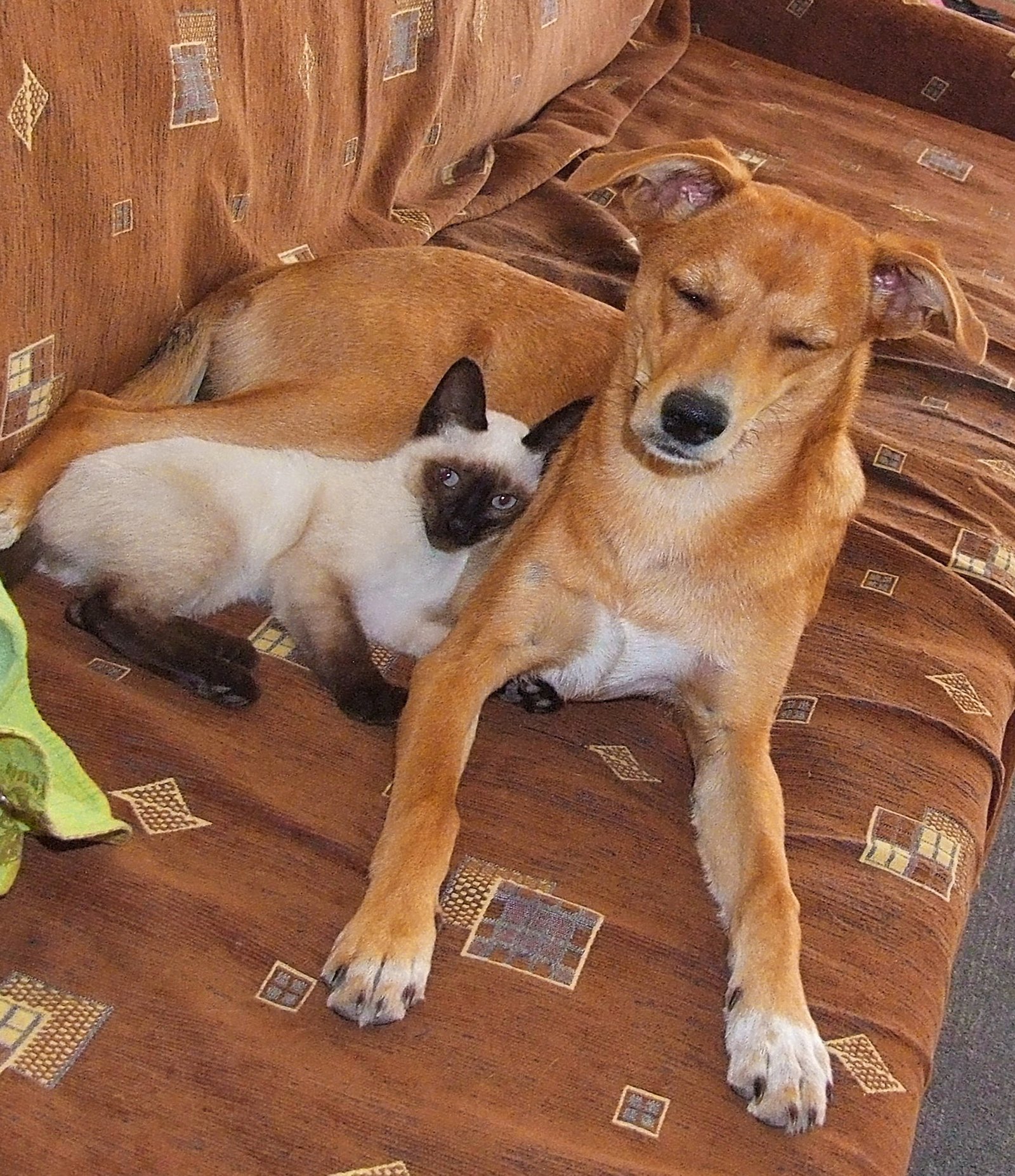
You open the door with a nervous kitten carrier in one hand and a curious dog on a leash in the other. Your heart is doing a small drum solo. Will they fight? Will the dog chase the cat into the curtains? Will this end with a scratch, a snap, or two animals who never share a couch?
You are not alone. The most common question vets hear from families adding a second species is some version of “how do I introduce a cat to a dog without disaster?” Most cat-and-dog households settle into a calm routine within two to four weeks, and the slow method below is the same protocol shelter behaviorists use.
Why the slow method works
Dogs and cats speak different body languages. A wagging tail reads as friendly to you, but to a cat it can look like a threat display. A cat hiss is a clear boundary. A dog who rushes in to “say hi” may simply be social, but the cat experiences it as a predator closing distance.
Veterinary behaviorists call this “desensitization and counter-conditioning.” In plain English: you let the two animals get used to each other’s smell, sound, and shape before they share a room. That slow build-up rewires the brain so the other animal becomes a predictor of good things instead of a trigger for chase or fear.
Skip those steps and the first impression sets the tone for months. Most fights between resident pets happen in the first 72 hours, and a single bad chase plants a memory that takes a long time to overwrite.
Prep checklist before the first nose-to-nose
Set up two separate “base camps” before you bring the new pet home. Each animal needs a room with food, water, litter box (for the cat), bed, and hiding spots.
- Trim the dog’s nails and confirm a secure harness or collar.
- Confirm the cat’s microchip and ID tag are current.
- Place a tall baby gate at the door between the two base camps.
- Stock low-value treats for the dog and high-value treats for the cat.
- Pick a neutral room for the first meeting. Not the dog’s couch. Not the cat’s sunny perch.
Most vets recommend keeping the new cat in their base camp for 48 to 72 hours before any visual contact so the cat can mark the room with cheek rubs (which contain calming pheromones) and feel safe.
The 7-day scent swap protocol
This is the heart of the slow method. You are teaching both animals that the other one’s smell predicts good things.
Days 1 to 2: swap blankets
Rub a soft cloth on the cat’s cheeks (where the pheromone glands are) and place it near the dog’s food bowl. Rub a separate cloth on the dog’s flanks and place it near the cat’s resting spot. Reward calm behavior with treats.
Days 3 to 4: swap rooms
Put the dog on a leash in another part of the house and let the cat explore the dog’s base camp. Then reverse. Each animal walks through the other animal’s territory without meeting face-to-face.
Days 5 to 6: feeding on either side of a closed door
Place each bowl a few inches from the shared door. If either refuses to eat, move the bowls back a few feet and work closer over several sessions.
Day 7: visual through a barrier
Open the door with the baby gate up. Both animals can see and smell each other but cannot touch. Keep sessions short and end on a calm note.
The first face-to-face meeting
Pick a quiet time when both animals are a little tired. The dog is on a leash held by a calm adult. The cat has a clear escape route and a high perch.
Let the cat set the pace. If the cat walks away, let the cat walk away. If the dog lunges or barks, end the session and go back a step. Three short sessions on day one beats one long one that ends in a chase.
Reward the dog for looking at the cat and then looking back at you. Reward the cat for any calm behavior, even if it is just sitting six feet away and watching.
Set up base camps
The resident pet (let’s say the cat) gets their own room with everything they need: food, water, litter box, scratching post, hiding spots, vertical space. The new pet (the dog) gets the rest of the house. They’ll smell each other under doors, which is the gentlest introduction possible.
Tire the dog out
The morning of the first visual introduction, take the dog for a 30-45 minute walk or run. A tired dog is a calm dog. A calm dog is a curious dog, not a prey-driven dog.
The baby gate method
Install a baby gate across the door to the cat’s room. Open the door. Let them see each other. Don’t force anything.
- Keep sessions short: 5-10 minutes the first day, working up to 20-30 by Day 3.
- Watch body language, not noise. Hissing is normal. Growling is normal. What matters is posture.
Good signs (continue):
- Loose, wagging tail (dog) or upright bottle-brush tail (cat, but not puffed)
- Slow blinks from the cat
- Sniffing toward each other
- Brief approach-then-retreat games
- Eating treats in the other’s presence
Bad signs (abort the session):
- Stiff body posture, frozen
- “Whale eye” (white of the eye visible)
- Low growl that escalates
- Cat puffed up like a Halloween prop
- Dog fixating, not breaking eye contact
- Any lunge
If you see bad signs, calmly end the session. Don’t scold anyone. Close the door, take a break, try again tomorrow. Don’t progress to the next step until you have 3 consecutive good sessions.
The “treat parade” trick
While the cat is on one side of the gate and the dog on the other, calmly toss high-value treats to both. They’re learning: “the other one nearby = treats happen.” This is the same principle zoos use to introduce incompatible species. It works.
Supervised together time (Day 4-14)
Once you have several good visual sessions under your belt, it’s time for the first face-to-face. Leashes on both for the first week. The cat gets a harness if they’ll tolerate it (most cats won’t). The dog gets a leash with someone holding it.
Parallel feeding
Once visual introductions are calm, start feeding them on opposite sides of the same door, then progressively closer (just outside the door, then 3 feet apart, then 1 foot). They’ll start associating “the other one nearby” with the most positive thing in their life: food.
Troubleshooting
Some pairs take longer than a week. A senior dog who has never lived with a cat may need three to four weeks. A former stray cat who has never lived with a dog may need two months. The slow method still works; you just add more weeks between each step.
Warning signs you have moved too fast: prolonged hissing that does not stop after the cat leaves the room, the dog fixating on the door for more than a minute, the cat hiding for more than 24 hours and refusing food. If you see any of those, drop back one step and call your vet or a certified behaviorist (CAAB or DACVB).
Never punish a hiss or a growl. Those are information. They are how your pets tell you the pace is too fast.
Products that make week one easier
The items our team and the behaviorists we work with reach for most when a family is blending a cat and a dog.
| Product | Best for | Price range | Why it works |
|---|---|---|---|
| Feliway MultiCat diffuser | Cat base camp | $25-$45 per diffuser | Releases a synthetic copy of the cat cheek pheromone and signals “this room is safe” |
| Adaptil dog-appeasing pheromone diffuser | Dog base camp | $25-$40 per diffuser | Mimics the pheromone a mother dog releases to calm puppies, which lowers arousal |
| Carlson extra-wide baby gate with walk-through door | Doorway between base camps | $40-$70 | Tall enough for most medium dogs, walk-through door so you do not have to climb over it six times a day |
| Cat tree or tall window perch | Neutral meeting room | $60-$180 | Gives the cat a high escape route and a place to observe the dog from a safe height |
| Front-clip pet harness | First meetings and beyond | $20-$45 | Front-clip harnesses give you steering control and discourage pulling toward the cat |
| Snuffle mat or stuffed Kong | Dog during scent-swap days | $15-$30 | Keeps the dog mentally busy so the cat’s smells become background, not a headline |
You do not need every item on the list. Pick one from the cat column, one from the dog column, and one barrier, and you are set.
Frequently asked questions
Q: How long does it really take for a cat and dog to get along?
Most pairs reach calm coexistence in 2 to 4 weeks. Some need 2 to 3 months, especially older animals or those who have never lived with the other species.
Q: Is it okay to leave them alone together once they seem fine?
Wait until you have watched them interact calmly for at least two full weeks before leaving them unsupervised. Even friendly pairs squabble over food or a favorite nap spot.
Q: What if my dog kills small animals outside? Will it hurt the cat?
Not necessarily. Prey drive is trainable. Work with a certified force-free trainer (CPDT-KA or similar) on a solid “leave it” cue and a strong recall before any face-to-face introductions. Many high-prey-drive dogs live peacefully with house cats once trained.
Q: My cat keeps hissing through the baby gate. Should I give up?
No. Hissing is information, not failure. Drop back to the scent-swap step, move the food bowls further from the door, and try again in 48 hours. If hissing continues for more than a week, ask your vet about a behaviorist referral.
Q: We adopted a puppy and a senior cat. Does the slow method change?
Yes: protect the senior cat’s space ruthlessly. Puppies have huge social energy and zero manners. Give the cat a “no puppy” zone with a tall gate the puppy cannot jump and a baby gate the cat can slip through but the puppy cannot.
The bottom line
The slow method works because it respects what each animal is actually feeling. You are not forcing a friendship; you are giving two different species a chance to learn the other one is part of the household and not a threat. Prep two base camps, swap scents for a week, share meals through a closed door, then share a room. Most families who follow that order are sitting on the couch with a dog at their feet and a cat on the back of the sofa within a month.