
Most cooling vest guides never mention the one number that decides whether the thing will work at all.
Evaporative cooling vests — the soak-and-wear kind, which is nearly all of them — depend on water evaporating off the fabric. That process slows sharply around 50–60% relative humidity and stops delivering meaningful cooling above roughly 70%. Past that point you have strapped a wet, insulating layer onto a dog that is already struggling to lose heat.
So before comparing brands, check your climate. If you are in Florida, the Gulf Coast, or a British summer after rain, the honest answer is that no evaporative vest will do much, and your money is better spent on shade, timing and water.
If your air is dry, they work well — measurably so. Here is what the testing shows.
How we choose: these are not first-hand tests. Picks below are drawn from independent thermal-camera testing, published gear testing, and recurring themes in owner reports. Every claim links to its source.
The short answer
- Best overall in dry heat — Non-stop Dogwear Cooling Vest (not sold on Amazon)
- Best you can buy on Amazon — Ruffwear Swamp Cooler Vest
- Best on a budget — Back on Track Cool on Track
- Best for running — Non-stop Dogwear Cooling Pull-on Vest (not sold on Amazon)
- Best if you already use a harness — Ruffwear Swamp Cooler Harness
- Skip if you want real cooling — reflective-only jackets
One thing worth saying plainly: the vest with the strongest test results is not available on Amazon. Non-stop Dogwear sells boots, leashes and harnesses there, but not their cooling range — you have to buy those direct. The Chillybuddy isn’t on Amazon either. We’ve left all three in because they earned their place on the testing, not because they pay us anything. They don’t.
Some links below are affiliate links. If you buy through them we earn a commission at no extra cost to you. It doesn’t change what we recommend.
| Product | Best for | What owners praise | Most common complaint | |
|---|---|---|---|---|
| Non-stop Dogwear Cooling Vest | Most dogs in dry heat — the strongest cooling of the group | Dropped surface temperature by 85°F within three minutes in independent testing | Runs short in the back compared with other vests, leaving the rump exposed | Not on Amazon — buy direct |
| Ruffwear Swamp Cooler Vest | Large and long-bodied dogs needing full back coverage | Visible cooling on thermal imaging within five minutes of soaking | Bulky and stiff when wet, and tends to shift out of position during activity | Check price |
| Back on Track Cool on Track Cooling Coat | Budget buyers, and head-shy dogs who dislike pull-on garments | Good cooling performance at roughly half the price of the top picks | Needs more wringing out than others, dries slowly, and must be stored damp in a sealed bag to avoid mould | Check price |
| Non-stop Dogwear Cooling Pull-on Vest | Running and canicross, or layering under a harness | Full chest coverage and fits under a harness without bunching | Pull-on design is harder to get on and off, especially on a hot, impatient dog | Not on Amazon — buy direct |
| Chillybuddy Canine Cooling Jacket | Packing light — 3.9 oz, the most portable option | At 3.9 oz it is by far the most portable, combining reflective and evaporative layers | Sizing runs small, and evaporative cooling lasts less time than the alternatives | Not on Amazon — buy direct |
| Ruffwear Swamp Cooler Harness | Active dogs, when you want cooling and a harness in one piece | Integrated harness eliminates the vest-under-harness layering problem, with cooling comparable to the standalone vest | Less back coverage than the vest, and users report dogs falling between sizes | Check price |
| Hurtta Cooling Wrap | Measurable cooling in moderate humidity | Roughly 8°C cooler under the wrap than exposed skin, measured after a 30-minute walk at 55% humidity | Needs about half a litre of water to charge properly — more than owners expect to carry | Check price |
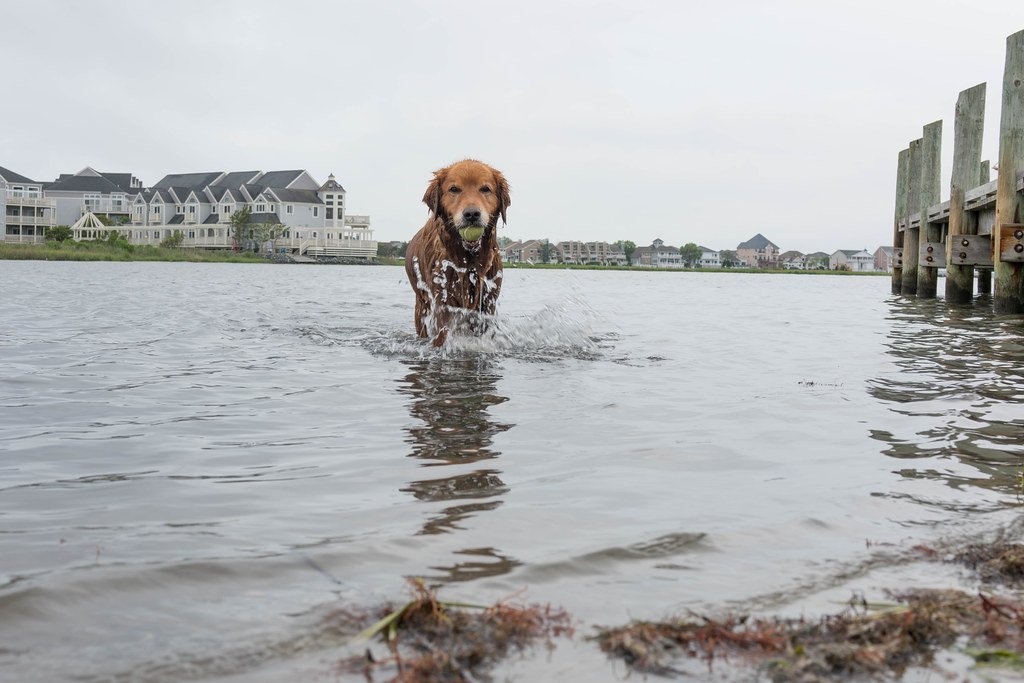
Why humidity decides everything
A dog sheds heat mainly by panting — evaporating moisture from the tongue and airway. An evaporative vest works the same way, using fabric instead of a tongue. Both depend on the surrounding air being dry enough to accept more moisture.
Independent thermal camera testing measured roughly 8°C cooler under a soaked Hurtta wrap than on exposed skin after a 30-minute walk at 55% humidity. That’s a real, useful effect. But the same testing notes evaporation slows on humid days, and gear testing conducted in 5–30% humidity carries the explicit caveat that results do not transfer to humid environments.
There’s field evidence behind the dry-climate case: working dogs — search-and-rescue and police K9s — showed a slower rise in core temperature when wearing evaporative vests, letting them work safely for longer. That’s the strongest evidence available, and it comes from dry-heat deployments.
The practical rule: below 50% humidity, a vest earns its place. Between 50% and 70%, expect much less. Above 70%, leave it at home and walk at dawn instead.
Reflective vests are a different product
Worth separating, because the marketing blurs it. Reflective jackets like the Chillybuddy and Saratoga K9 showed minimal thermal difference after a 30-minute walk in the same thermal imaging test. They slow heat gain from sunlight. They do not actively cool.
That’s still useful for a black-coated dog in open sun. It is not the same thing as a soaked evaporative vest, and if you buy one expecting cooling you’ll be disappointed.
The vests, in detail
Non-stop Dogwear Cooling Vest — best overall
Three-layer construction with reflective panels. Gear testing recorded a surface temperature drop of 85°F within three minutes, and thermal imaging showed the soaked fabric as the coldest surface in frame.
The catch: it runs short in the back, leaving the rump exposed. Not for long-backed breeds — a Dachshund or a Corgi will be part-covered.
Ruffwear Swamp Cooler Vest — best for big dogs
Second-best cooling of the group with the most generous back coverage, six sizes from XXS to XL, and a UPF 50+ outer layer. Cooling was visible on thermal imaging within five minutes.
The catch: bulky and stiff once wet, and it shifts out of position during activity. Not for dogs that need it to stay put while running.
Back on Track Cool on Track — best budget option
Roughly half the price of the top picks with genuinely good cooling. The Velcro closure means nothing goes over the dog’s head, which matters more than it sounds for head-shy dogs.
The catch: it needs more wringing out than the others, dries slowly, and has to be stored damp in a sealed bag or it develops mould. Not for multi-day trips.
Non-stop Dogwear Cooling Pull-on Vest — best for running
Full chest coverage, fits under a harness without bunching, and eleven sizes — the widest range here, which matters because fit drives how much fabric contacts the dog.
The catch: the pull-on design is awkward to get on and off, particularly on a hot, impatient dog. Not for head-shy dogs.
Ruffwear Swamp Cooler Harness — best all-in-one
Solves the layering problem by building cooling into the harness itself, with cooling comparable to the standalone vest.
The catch: less back coverage, and owners report dogs falling between sizes. Not for in-between dogs — measure carefully.
Chillybuddy Canine Cooling Jacket — lightest
At 3.9 oz it packs down smaller than anything else here.
The catch: sizing runs small and the evaporative effect fades faster. As a reflective-led design it prevents heat gain more than it cools. Size up, and buy it for portability, not performance.
Hurtta Cooling Wrap — best measured performance
The only product here with a published under-vest temperature delta at realistic humidity: about 8°C cooler than exposed skin at 55%.
The catch: it takes roughly half a litre of water to charge properly, which is more than most people carry on a walk.
How to actually choose
- Check your humidity first. Above 70%, none of these will help. This decides more than brand ever will.
- Measure your dog, don’t guess the size. A vest that gapes contacts less fur and cools less. Sizing complaints are the single most common issue across every product here.
- Match the closure to the dog. Head-shy dogs need Velcro, not pull-on.
- Think about where it dries. A vest that must be stored damp needs a plan on holiday.
- Consider whether you need a harness anyway. If so, the integrated Ruffwear removes a layer.
What a vest can’t do
A cooling vest is a margin, not a safety net. It buys time on a walk you slightly misjudged. It does not make a hot car survivable, it does not offset humidity, and it will not protect a dog that keeps running past its limit.
Flat-faced breeds deserve particular caution. Pugs, French Bulldogs and Boxers deteriorate far faster than a Labrador in the same conditions, because the airway that should be doing the cooling is already compromised. A vest does not change that.
If you’re unsure what heat stress looks like, or what to do in the first ten minutes, our guide to heatstroke in dogs covers the symptoms and the first aid — including why the old cold-water advice turned out to be wrong.
Frequently asked questions
Do dog cooling vests actually work? In dry air, yes — independent thermal testing measured around 8°C cooler under a soaked vest than on exposed skin at 55% humidity. Above roughly 70% humidity, evaporation stalls and the benefit largely disappears.
How long does a cooling vest stay cool? Several hours in dry, moving air; far less in humid or still conditions. Re-wet whenever the fabric stops feeling cold, which is the only reliable indicator.
Can I use cold water to soak it? Yes. The concern about cold water being dangerous for dogs is a myth that current veterinary evidence does not support — covered in our heatstroke guide.
Are cooling mats better than vests? They do a different job. Mats use phase-change materials and work by conduction while a dog rests — useful at home or in a crate. Vests work while moving. Neither is a substitute for shade and timing.
Will a cooling vest prevent heatstroke? No. It slows the rise in core temperature and buys margin. Prevention is walking early or late, avoiding hot pavement, and carrying water.
The bottom line
Check your local humidity before you buy anything. Under 50%, the Non-stop Dogwear vest is the strongest performer and the Back on Track does most of the job for half the money. Over 70%, save your money — no vest will overcome the physics, and the walk timing matters more than the gear.
—
This article is general guidance, not veterinary advice. If you suspect heat illness, contact your vet immediately.
Sources: Dog Gear Review — thermal camera testing of 9 cooling vests · Treeline Review — dog cooling vest testing · AKC — cooling mats for dogs