
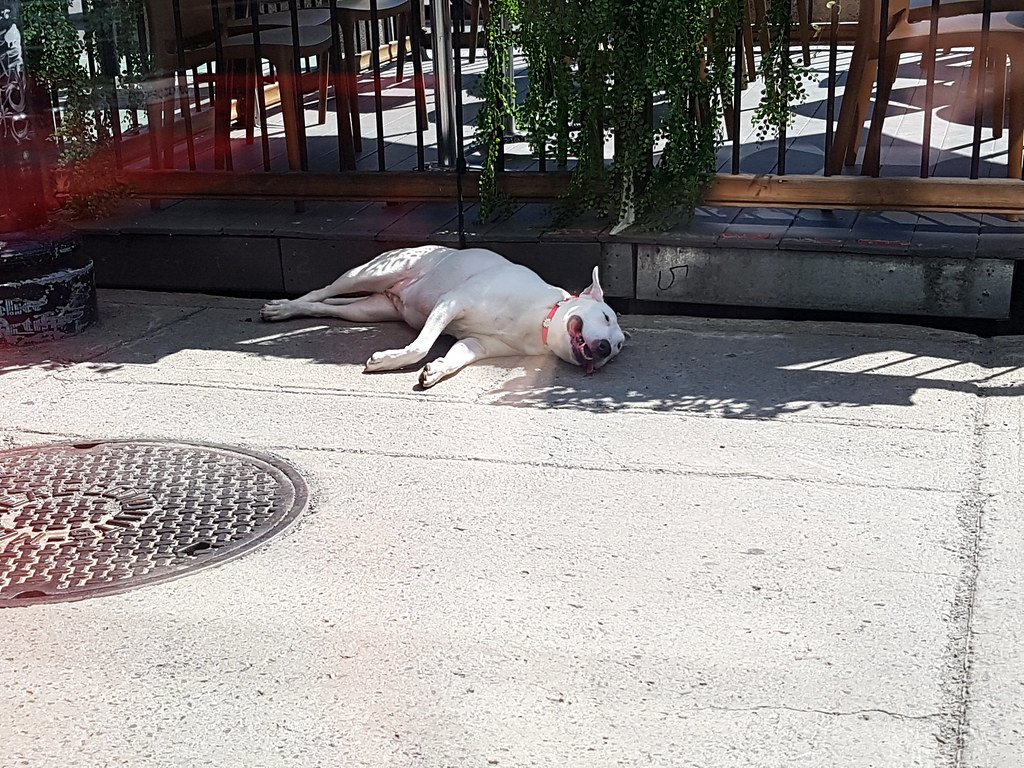
Ninety-seven percent of dogs treated for mild heat-related illness survive. For dogs that reach severe heatstroke, survival drops to 43%.
That gap is the whole story. Heatstroke is not a condition where you wait and see whether it gets worse — the waiting is what makes it worse. Research from the Royal Veterinary College’s VetCompass programme found that of 623 heat-related illness cases, only 21.7% of dogs were cooled before being driven to the vet. Most owners did the thing that feels responsible — bundle the dog in the car and go — when the evidence says to get them wet first.
This guide covers what heatstroke actually does, how to recognise it early, and what to do in the first ten minutes. It also corrects a piece of first aid advice that circulated for decades and turns out to be backwards.
What heatstroke actually does to a dog
Dogs cannot sweat the way we do. A dog sheds heat almost entirely through panting — evaporating moisture from the tongue, mouth and upper airway — plus a small amount through the paw pads. That system works well in dry, moving air. It fails badly in humidity, in a stationary car, or when a dog is already struggling to breathe.
When core temperature climbs past roughly 40°C (104°F), the body stops keeping up. Above about 41°C (106°F), proteins begin to denature and cells start dying. The damage cascades: the gut lining breaks down and leaks bacteria into the bloodstream, the kidneys and liver take a hit, and the clotting system can spiral into disseminated intravascular coagulation. A dog can look like it recovered, then deteriorate 12 to 48 hours later from organ injury that was already underway.
This is why “he seems fine now” is not a reason to skip the vet. The visible crisis and the actual damage run on different clocks.
Symptoms, in the order they usually appear
Early — act now, don’t wait for more:
- Heavy, frantic panting that doesn’t settle when the dog rests
- Drooling more than usual, often thicker and ropier
- Bright red gums and tongue
- Seeking shade, lying down, refusing to continue a walk
- Restlessness or whining
Escalating — this is an emergency:
- Wobbly, drunken gait or weakness in the back legs
- Vomiting or diarrhoea, sometimes with blood
- Gums going pale, grey or tacky rather than red
- Glassy eyes, disorientation, not responding to their name
Critical — cool immediately and call ahead:
- Collapse
- Seizures
- Unconsciousness
The reluctance to keep walking is the one most owners miss. A dog that plants itself in the shade and won’t move is often making a better decision than the person holding the lead.
The cold water advice changed — here’s what the evidence says now
For years, standard first aid advice warned against cold or iced water. The reasoning sounded plausible: cold water constricts the blood vessels near the skin, traps hot blood in the core, and could tip a struggling dog into shock. You’ll still find this repeated across pet blogs, including in older articles on this site.
The evidence does not support it.
Studies looking directly at this found no difference in outcome between ice-water immersion (1–3°C) and cold-water immersion (15–16°C) in dogs. The feared complications — hypothermic overshoot, vasoconstriction blocking the cooling response, cardiogenic shock — did not occur. A canine study going back to 1980 found conscious dogs cooled faster in 1–16°C water than in 18–25°C water. The veterinary education project Hot Dogs, run by the researchers behind the VetCompass heatstroke work, now lists the cold-water warning explicitly as a myth.
The real danger was never the water temperature. It was the hesitation the advice created. The same VetCompass analysis found 51.3% of owners reached for wet towels — one of the least effective methods available — while only 24% used a method the evidence actually supports.
Here’s the practical version:
Any water cooler than your dog is better than no water. Do not stand there deciding whether it’s cold enough. Get them wet.
For a young, healthy, conscious dog: cold water immersion is the most effective method. A paddling pool, a stream, a bath, a hose run steadily over the body.
For an older dog, a puppy, a dog with heart or airway disease, or any dog that is unconscious or seizing: pour water over them continuously and get air moving — a fan, an open car window, an air conditioner. This is evaporative cooling, and it is safer where immersion carries a drowning or shock risk.
Stop cooling at around 39.5°C (103°F). Temperature keeps falling after you stop, and overshooting into hypothermia is its own emergency. Without a thermometer, cool for roughly ten to fifteen minutes, then move.
Cool first, transport second
This is the single change most likely to save a dog’s life, and it runs against instinct.
Dogs cooled before transport arrived at the clinic averaging 38.6°C. Dogs cooled only once they got there arrived at 40.9°C — well into the range where organ damage accumulates. Every minute spent above 41°C is doing measurable harm, and a car journey is dead time unless you have already started cooling.
The UK veterinary shorthand is “wet then vet.” In practice:
- Get the dog out of the heat and into shade or air conditioning.
- Start cooling — water over the body, air moving across it.
- Have someone phone the vet while you cool, so the clinic is ready.
- Cool for ten to fifteen minutes, then drive with the air conditioning on and windows open.
- Keep cooling in the car if a second person can.
If you are alone and the dog is critical, cool where you are and call. Do not sacrifice cooling time for driving time.
Which dogs are at the highest risk
- Flat-faced (brachycephalic) breeds — Pugs, French Bulldogs, English Bulldogs, Boxers, Shih Tzus. Their airway anatomy makes panting far less effective. They can deteriorate in a fraction of the time a Labrador would take.
- Overweight dogs — extra insulation, more heat generated, less efficient breathing.
- Senior dogs — reduced cardiovascular reserve and blunted thirst. If you have an older dog, our senior dog care guide covers the wider picture of what changes with age.
- Thick or dark-coated breeds — Huskies, Malamutes, Newfoundlands, and any black-coated dog in direct sun.
- Dogs with heart or respiratory conditions — less margin before the system fails.
- Puppies — immature thermoregulation.
Worth stating plainly: every dog is susceptible. The single most common scenario in the VetCompass data is not a dog left in a car. It’s exercise on a warm day.
Prevention that actually works
Walk on the clock, not the temperature. Early morning and late evening. If the day has already warmed up, skip it — a missed walk costs nothing.
Test the pavement. Back of your hand on the tarmac for seven seconds. If you can’t hold it there, it’s too hot for paws. This also tells you how much radiant heat your dog is walking through, which matters more for a short dog than a tall one.
Never leave a dog in a parked car. Not with the windows cracked, not for five minutes, not in the shade. On a 22°C day a car interior can pass 47°C within an hour.
Carry water on every warm-weather walk, and offer it before your dog looks like they need it.
Watch humidity, not just temperature. Panting is evaporative. In high humidity, evaporation slows and a 24°C muggy day can be more dangerous than a dry 28°C one.
Check your harness and lead setup for hot-weather walks — a well-fitted harness that doesn’t trap heat across the chest makes a difference on long summer routes. We covered fit and materials in our dog harness testing.
For the broader hot-weather picture including travel and garden hazards, see our summer pet safety guide.
What the vet will do, and what it costs
Expect intravenous fluids, active cooling, oxygen if breathing is compromised, and bloodwork to check kidney, liver and clotting function. Severe cases need 24 to 72 hours of hospitalisation because the organ damage declares itself late.
Costs vary widely by region and severity. A mild case caught early may be a consultation and a few hours of monitoring. A severe case with multi-day intensive care and repeat bloodwork runs into four figures in most markets.
This is one of the scenarios where insurance earns its keep, since heatstroke is sudden, expensive, and not something you can budget for. We broke down the maths in our pet insurance cost-benefit analysis.
Gear worth having before you need it
Some links below are affiliate links. If you buy through them we earn a commission at no extra cost to you. It doesn’t change what we recommend.
We compared seven cooling vests on independent thermal-camera data in our guide to dog cooling vests — including the humidity threshold above which none of them work.
None of this replaces shade, water and judgement. What it does is shorten the gap between “something is wrong” and “the temperature is coming down.”
- A cheap digital rectal thermometer. The least glamorous item here and the most useful. Without it you are guessing, and guessing is how people overshoot into hypothermia or stop cooling too early.
- A collapsible water bowl and an insulated bottle. So water is genuinely available, not theoretically available in the boot.
- A cooling mat for the car and the house. Pressure-activated gel mats need no power and no freezer.
- A battery clip-on fan. Evaporative cooling needs moving air. A fan is what turns wet fur into actual heat loss.
- A cooling vest or coat for flat-faced and dark-coated dogs. Soak, wring, fit. It buys time on a walk you misjudged.
Frequently asked questions
How quickly can heatstroke kill a dog? In severe cases, under an hour. Flat-faced breeds and dogs left in cars can deteriorate in fifteen to thirty minutes. Once core temperature passes 41°C, damage accumulates by the minute.
Is cold water really safe? Yes, for a conscious dog. The concern about cold water causing shock or trapping heat is not supported by the evidence, and studies found the predicted complications didn’t occur. For unconscious dogs or those with heart conditions, pour water and use a fan rather than immersing them.
Should I use ice packs? Not as your primary method — direct ice on skin can cause cold injury and cools too small an area. Water over the whole body with airflow works better. If ice is all you have, put it in water rather than against the dog.
My dog seems fine now. Do I still need a vet? Yes. Organ damage from heatstroke frequently declares itself 12 to 48 hours later. A dog that looks recovered can still be in trouble.
What temperature is too hot to walk a dog? There’s no single number, because humidity, coat, age and breed all shift it. Above roughly 20°C, be cautious with a flat-faced or senior dog. Above 24°C, most dogs are better off walking early or late. Use the seven-second pavement test as your check.
Can cats get heatstroke? Yes, though it’s less common because cats are better at seeking cool spots and rarely get exercised in heat. The same cooling principles apply.
The bottom line
Heat illness caught early is survivable in 97% of cases. Let it become severe and it’s close to a coin flip.
Three things matter more than everything else on this page: recognise the early signs and stop, get the dog wet with whatever water is cooler than they are, and cool before you drive rather than after. The old advice to avoid cold water cost dogs time, and time is the only variable you fully control.
If you’re reading this because something is happening right now — stop reading, start cooling, and call your vet.
—
This article is general guidance, not veterinary advice. If you suspect heatstroke, contact your vet or an emergency clinic immediately.
Sources: RVC VetCompass heatstroke research · Cooling Methods Used to Manage Heat-Related Illness in Dogs, Veterinary Sciences (2023) · Hot Dogs — Myth busting: cooling hot dogs · Cornell Riney Canine Health Center — summer heat safety