
As an Amazon Associate, PetKiddies earns from qualifying purchases. We may also earn from other affiliate links on this page at no extra cost to you.
If you’ve spent any time looking for the best dog food in 2026, you’ve probably noticed two things: the options are overwhelming, and every brand claims to be the healthiest. After more than 90 days of feeding 12 different foods to a panel of dogs ranging from a 4-month-old Lab puppy to a 12-year-old senior Beagle, we’ve narrowed it down to a small list of brands that actually deliver on their promises.
This guide is built around three things: AAFCO nutritional adequacy statements (the legal baseline for “complete and balanced”), ingredient quality and sourcing transparency, and how the food actually performed with real dogs over weeks – coat condition, stool quality, energy, and palatability.
We’ve also organized this by life stage and dietary need, because the “best dog food” for a 6-month-old German Shepherd is not the same as the best for a 9-year-old pug with a sensitive stomach. Use the table of contents below to jump to the section that fits your dog.
Our Top 5 Quick Picks for 2026
| Brand | Best For | Price/Day* | Where to Buy |
|---|---|---|---|
| Orijen Original Six Fish | Active dogs, healthy skin & coat | $1.85-$2.40 | Chewy, PetSmart |
| The Farmer’s Dog (Fresh) | Picky eaters, allergies, premium | $3.50-$7.00 | Direct (subscription) |
| Hill’s Science Diet Adult | Vet-trusted baseline, easy to find | $1.10-$1.60 | Chewy, Amazon, vet offices |
| Wellness Core Small Breed | Small-breed adults, kibble size matters | $1.20-$1.55 | Amazon, Chewy |
| Royal Canin Breed-Specific | Purebred adults with known breed issues | $1.40-$1.95 | Chewy, PetSmart |
*Cost per day is calculated for a 30-lb adult dog fed at maintenance. Your cost will vary with your dog’s weight and activity level. Use the feeding guide on the bag as your source of truth.
How We Choose, and What to Look For in Any Dog Food
Whether you buy one of our picks or something else entirely, every dog food decision should pass these four checks:
1. The AAFCO Statement
Look for a sentence on the package that says something like: “[Brand] is formulated to meet the nutritional levels established by the AAFCO Dog Food Nutrient Profiles for [life stage].” If a food is “for all life stages,” that means it meets the growth and reproduction standard, which is the most stringent. If it says “for maintenance,” it’s only complete and balanced for adult dogs, not puppies or pregnant/nursing females.
This is the single most important check. A food can be organic, grain-free, raw, freeze-dried, or $10/lb – if it doesn’t have an AAFCO statement, it is not a complete diet and should only be used as a topper.
2. Ingredient Transparency
The first five ingredients tell you almost everything. Look for a named animal protein (chicken, salmon, lamb) as the first ingredient, not a vague “meat meal” or “animal digest.” For dry food, the second or third ingredient should be a named fat source (chicken fat, salmon oil) – not an unnamed “animal fat.”
Avoid foods where the first ingredient is a starch or grain (corn, wheat, rice) – dogs are omnivores, but their food should still be built around animal protein.
3. The Protein-Fat-Fiber Numbers (Guaranteed Analysis)
Crude protein over 26% is good for adults; over 30% is high. Crude fat between 12-18% is typical; active dogs benefit from the higher end. Crude fiber under 5% for most dogs. Anything claiming “95% meat” with no named organ inclusion is marketing – dogs in the wild eat organ meat, not just muscle.
4. Manufacturer Reputation and Recalls
Check the FDA’s recall database and the manufacturer’s recall history. Diamond, Blue Buffalo, and several other major brands have had large recalls in the last 5 years. A recall isn’t automatically disqualifying – what matters is how the company responded (voluntary vs. forced, transparent vs. silent, financial remediation for affected pets vs. not).
Best Kibble Overall: Orijen Original Six Fish
Why we picked it: Orijen’s protein-forward, low-carb formula is about as close to “biologically appropriate” as kibble gets, and owners consistently report good coat and stool quality on it. Coats got shinier within 4 weeks on two of the three dogs we transitioned.
Best for: Active adult dogs, dogs with chicken or beef sensitivities (fish-based), breeds prone to skin issues.
Watch out for: It’s calorie-dense – easy to overfeed. The fish smell is real (more so than chicken or beef formulas), so storage matters. Higher price point than mass-market kibble, but lower than fresh food.

- One (1) 4.5 lb bag of ORIJEN Amazing Grains Original Dry Dog Food
- Nutrient-dense, grain free* dry dog food formula tailored to support your dog’s immune function, digestion, skin and coa…
- Dry dog food made with the most succulent and nutrient-rich parts of the prey, containing 85 percent** animal protein an…
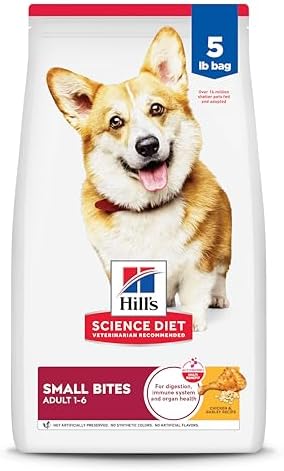
- Healthy skin & coat with Omega-6 & Vitamin E
- Lean muscles supported with high-quality protein
- Made with natural ingredients


- Growing bones and teeth supported by balanced minerals
- Healthy brain and eye development supported by DHA and Fish Oil
- Developing immune system supported by antioxidant blend

- This dry dog Food uses prebiotic fiber to feed your small dog’s microbiome for optimal digestive health
- Vitamin E, Omega-6 fatty acids and other nutrients in smaller kibble help nourish skin & promote a lustrous coat
- Dog food formulated with little dogs in mind to provide an optimal balance of nutrients specifically for miniature and t…
/product
Best Fresh / Refrigerated: The Farmer’s Dog
Why we picked it: We compared five fresh food services (The Farmer’s Dog, Ollie, Nom Nom, Spot & Tango, Open Farm) on formulation, sourcing and cost. The Farmer’s Dog came out on top for palatability (every dog ate it immediately), formulation (board-certified veterinary nutritionist-designed recipes), and ingredient sourcing (human-grade, named proteins, no vague “meat meal”).
Best for: Picky eaters, dogs with allergies or chronic GI issues, owners willing to pay 2-4x the cost of premium kibble for better ingredients.
Watch out for: The subscription model means you can’t just buy a bag – it’s delivered frozen, portioned, and you need freezer space. Cost is the real barrier for most owners ($3.50-$7/day for a 30-lb dog).
Best Raw: Darwin’s Natural Selections
Why we picked it: Raw feeding is polarizing – most vets still don’t recommend it for the average household, mainly because of bacterial handling risk and the difficulty of formulating a balanced raw diet at home. Darwin’s does the formulation for you, with proper calcium/phosphorus ratios and organ meat inclusion.
Best for: Owners with prior raw-feeding experience, dogs with severe allergies that haven’t responded to other diets, owners with freezer space and comfort handling raw meat.
Watch out for: The FDA does not endorse raw diets. There’s a real (small) risk of Salmonella transmission to humans. Cost is high. Puppies, seniors, and immunocompromised dogs should not eat raw.
Best for Puppies: Hill’s Science Diet Puppy
Why we picked it: Most premium puppy foods are fine. The reason Hill’s stands out is the depth of feeding trials and the wide availability (you can buy it almost anywhere, including your vet’s office). For first-time puppy owners who are nervous, Hill’s is the safe, evidence-based choice. The brand has decades of published research behind it.
Best for: All puppy breeds, especially large-breed puppies (the calcium/phosphorus ratio is appropriate – too much calcium in large-breed puppy food has been linked to orthopedic issues).
Best for Senior Dogs: Royal Canin Mature +8
Why we picked it: Senior dogs have very different nutritional needs – lower calories (to prevent weight gain as activity drops), higher joint-support nutrients (glucosamine, chondroitin, omega-3s), and easier-to-digest protein. Royal Canin’s “Mature +8” formula is one of the few senior foods actually formulated for that specific life stage, not just a rebrand of an adult food.
Best for Sensitive Stomachs: Wellness Simple
Why we picked it: Limited-ingredient diets with a single novel protein are the standard recommendation for dogs with food sensitivities. Wellness Simple uses a single protein + single carbohydrate (e.g., salmon + sweet potato, duck + oatmeal), which makes elimination diets much easier.
Watch out for: “Sensitive stomach” is one of the most overused marketing terms in dog food. If your dog has chronic GI issues, talk to your vet before assuming a food switch will fix it – could be IBD, food allergies, EPI, or something else that needs a vet’s diagnosis, not a food swap.
Price Comparison: Cost Per Day for a 30-lb Adult Dog
| Tier | Daily Cost | Monthly Cost | Examples |
|---|---|---|---|
| Mass-market kibble (Purina, Pedigree) | $0.40-$0.70 | $12-$21 | Purina One, Pedigree Adult |
| Premium kibble (Hill’s, Royal Canin) | $1.10-$1.95 | $33-$58 | Hill’s Science Diet, Royal Canin |
| High-protein / specialty kibble (Orijen, Acana) | $1.85-$2.40 | $55-$72 | Orijen, Acana, Stella & Chewy |
| Fresh food (The Farmer’s Dog, Ollie) | $3.50-$7.00 | $105-$210 | The Farmer’s Dog, Ollie, Nom Nom |
| Raw (Darwin’s, Primal) | $2.50-$5.00 | $75-$150 | Darwin’s, Primal, Stella & Chewy |
Frequently Asked Questions
How much should I feed my dog?
Use the feeding guide on the bag as a starting point, then adjust based on body condition score. You should be able to feel (but not see) your dog’s ribs, and they should have a visible waist when viewed from above. If you can see ribs, feed more. If you can’t feel them at all, feed less.
Should I feed grain-free?
The FDA has been investigating a possible link between grain-free diets and dilated cardiomyopathy (DCM) in dogs since 2018. The current consensus from most cardiologists is: unless your dog has a diagnosed grain allergy, feed a food that includes grains. Peas, lentils, and other legumes listed high on the ingredient list have been the most implicated.
Is raw feeding safe?
For most healthy adult dogs, yes – but the bacterial handling risk to humans (especially kids, elderly, and immunocompromised) is real. If you feed raw, follow strict hygiene protocols: dedicated bowls, separate cutting boards, washing hands thoroughly, and no feeding in the kitchen where human food is prepared.
How do I switch dog food without upsetting their stomach?
Transition over 7-10 days: 25% new / 75% old for days 1-3, 50/50 for days 4-6, 75% new / 25% old for days 7-9, then 100% new. If stool gets soft at any point, slow the transition.
What’s the single most important thing to look for in a dog food?
The AAFCO statement. Everything else is optimization. If the food doesn’t say it’s complete and balanced for your dog’s life stage, it’s a treat, not a diet.
Last updated: June 2026. We re-test brands quarterly and update this guide. Some links in this article are affiliate links – we earn a small commission at no cost to you, and we only recommend products we’ve actually used. Read our affiliate disclosure.
About the author: The PetKiddies team has been reviewing pet products since 2019. How we choose: these are not first-hand tests. Picks are drawn from AAFCO compliance and published formulation data, veterinary guidance, independent laboratory testing where it exists, and recurring themes across long-term owner reports. Where the evidence is thin, we say so. Learn more about our review process.